
ES Windows Window Installation in Boca Raton: A Homeowner’s Guide
Here’s what most Boca Raton homeowners never learn until a claim gets denied: ES Windows builds a unit that can handle 180 mph winds, but the warranty lives or dies on whether your installer followed ES’s own installation specs. In South Florida’s rain exposure category, the most common shortcut we see is skipping the mandatory sill pan flashing, which happens to be the exact omission ES checks for first when a warranty claim lands on their desk.
What Makes ES Windows Worth Considering for a Boca Raton Home
ES Windows has earned its reputation in South Florida the honest way: aluminum frames engineered for salt air, heavy glass packages, and wind loads that would fold a lesser product. The company builds impact-rated windows and doors that meet Miami-Dade County’s strictest standards, which means any ES unit you install in Boca Raton has already passed testing far more brutal than anything Palm Beach County code will throw at it.
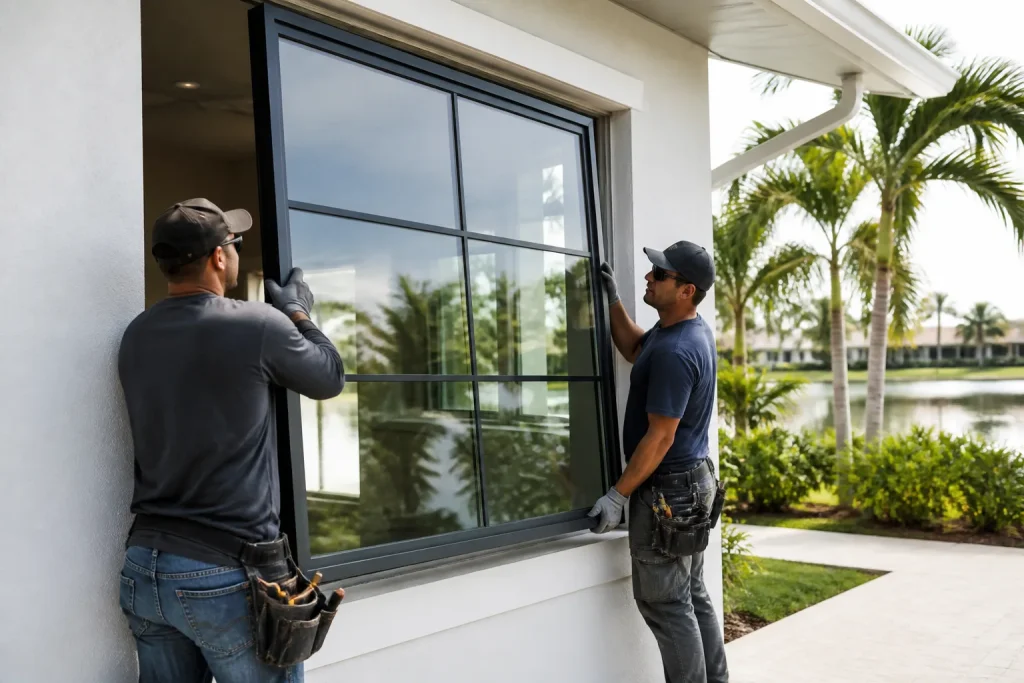
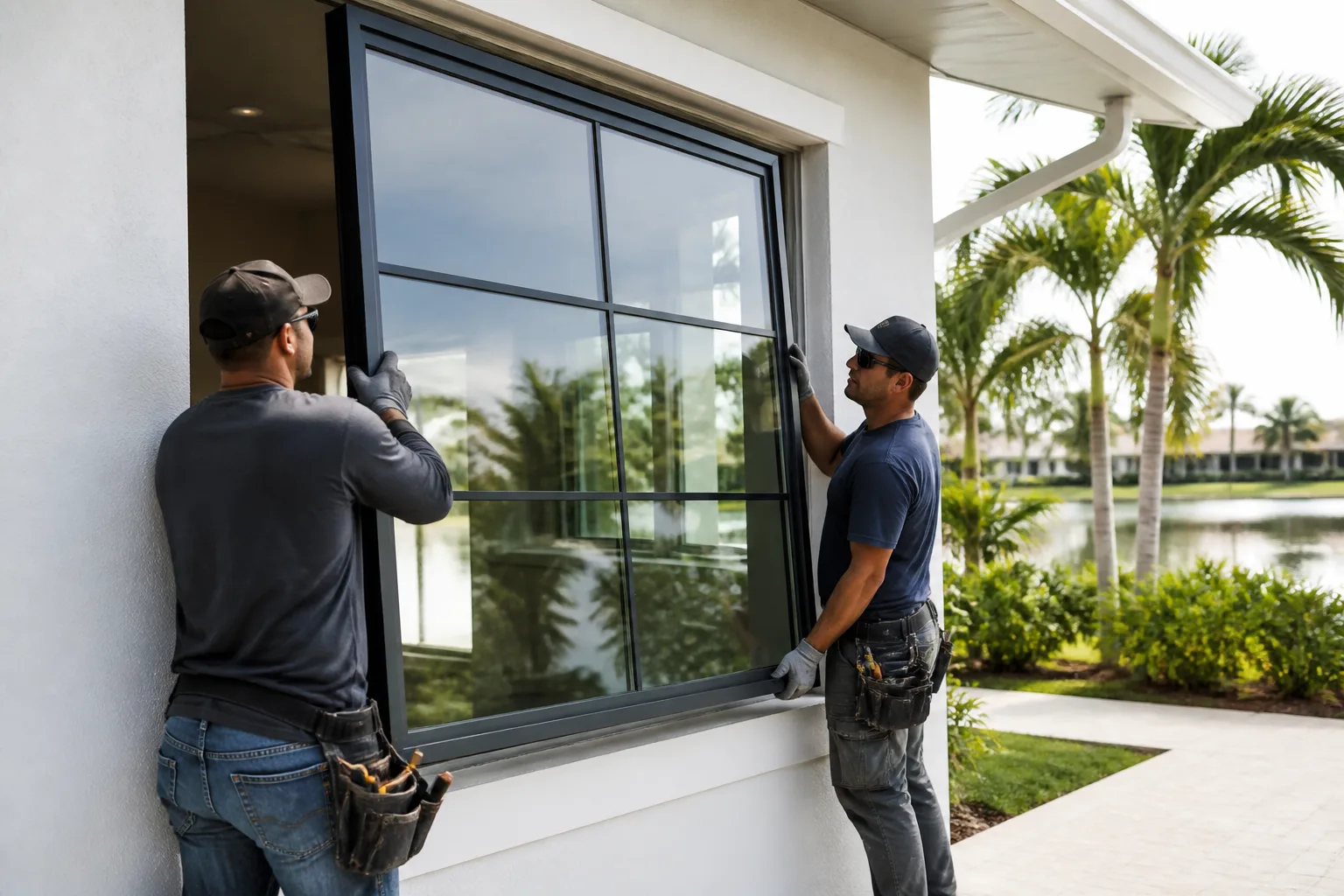
But here’s the part most homeowners miss. An ES window sitting in its factory crate is a fine piece of engineering. An ES window set into a rough opening by someone who measured once, skipped the flashing, and used whatever shims were rolling around the truck bed is a liability waiting for the first tropical storm. The unit is half the equation. The other half is the hands that set it and the attention paid to the manufacturer’s installation manual, which reads less like a suggestion and more like a condition of the warranty remaining valid.
We’ve pulled ES windows out of Boca Raton homes where the glass was pristine and the frame was square, but the install had voided the warranty outright. Missing sill flashing. No backer rod. Screws driven into the frame at intervals that would make an ES engineer wince. The homeowner paid for a premium product and got a voided warranty because the crew treated a Florida high-exposure install like an inland job in a dry climate.
For a broader look at how we approach window installation in Boca Raton across all manufacturers, we’ve written about that process in detail.
Why ES Specifically Fits Boca Raton’s Climate
Boca Raton sits in a corrosion zone most manufacturers treat as the top of the scale. Salt air from the Atlantic moves inland for miles. Summer humidity hovers above 80 percent for months. Convective thunderstorms dump inches of water in an afternoon. ES builds for exactly this environment: marine-grade aluminum frames, factory-applied finishes rated for coastal exposure, and weatherstripping designed to hold up when the wind drives rain horizontally against the fenestration.
What ES Windows’ Installation Documentation Actually Requires in Florida
ES maintains a series of installation manuals and Florida Product Approval documents that spell out precisely how each window series must be set, flashed, and fastened in high-wind and high-water-exposure zones. Boca Raton falls into that zone. The requirements are not generic best practices, they are the binding conditions of both the product approval and the manufacturer warranty.
Here is what ES’s own documentation requires, and what a homeowner should watch for:
- Sill pan flashing at every opening. Not optional. Not “if we have time.” A pre-formed sill pan or site-formed flashing that laps up the jambs, designed to direct any water that gets past the window back out to the face of the wall. Without it, ES will deny a water-intrusion warranty claim faster than you can say “mold remediation.”
- Shim placement at specific intervals. ES specifies shim spacing along the sill, jambs, and head. Gaps of 24 inches or more between shims leave the frame unsupported where wind pressure loads concentrate. We’ve seen frames bowed in the middle from installers who used three shims total on a six-foot window.
- Rough-opening tolerances. ES calls for a square and level opening with specific clearance between the frame and rough structure. A quarter-inch too tight on one side means the frame gets forced, which throws the sash out of plane. A half-inch too loose means the anchors are gripping substrate, not structure.
- Fastener type and spacing per wind-load zone. ES approves specific anchor types, embedment depths, and edge distances for Florida’s high-velocity hurricane zones. Drywall screws, tapcons through thin stucco only, or anchors spaced twice as far apart as specified are each individually enough to fail a Florida Product Approval inspection on a bad day.
If you are having ES windows installed in Boca Raton and want to hold the crew accountable, ask two questions before the first anchor goes in: “Show me the sill pan flashing plan for each opening,” and “Which fasteners does ES specify for this series in our wind zone?” The crew that can answer both without blinking is the crew that has read the manual. The crew that says “we’ve always done it this way” is the crew whose work you will be redoing after the first storm season.
ES-Authorized Installer vs. General Contractor Who Ordered ES Before
This distinction matters more than most homeowners realize, and it affects your warranty registration directly. An ES-authorized installer has gone through ES’s own factory training, carries current documentation from the manufacturer, and has a direct line to ES’s technical support when a job-specific question comes up. A general contractor who has simply ordered ES product before may set a fine window, but they have no standing relationship with the manufacturer when a claim needs to be filed.
Here is what the difference looks like in practice:
- An authorized installer knows which ES series requires which flashing detail because they’ve done it under factory supervision, not because they watched a video once.
- An authorized installer can register both warranty layers on site, with paperwork in hand, before the truck leaves your driveway.
- When ES updates an installation spec mid-year, the authorized installer gets the notice. The general contractor who ordered product in March might be installing by September’s spec in November.
- If a warranty question comes up three years after install, the authorized installer can call ES technical support and speak to someone who knows their account. The general contractor has to start from scratch with a serial number and a prayer.
TruePane is an authorized installer for more than a dozen manufacturer lines, including ES Windows. That authorization means the Keystone Standard applies to every ES job: both warranty layers registered in writing, durations stated clearly, before we pack up and leave.
If you’re comparing a few bids and one of them is an ES-authorized installer and the other is not, ask the unauthorized one a simple question: “When I have a warranty issue in three years, who do you call at ES?” The silence that follows is your answer.
How the Florida Product Approval Number Ties to Installation Method
Every impact window or door sold in Florida carries a Florida Product Approval number. That number is not a generic certification. It corresponds to a specific product, a specific set of installation methods, and a specific set of fastening schedules that the manufacturer submitted and the state approved as a package. Palm Beach County code enforcement checks, at inspection, that the installed window matches both the product and the method on that approval.
Here is what that means for your Boca Raton ES window install:
- The window itself must be the exact product listed on the approval. Different glass packages, different frame depths, different anchorage details all change the approval. If the installer ordered a close-but-not-exact unit, the approval number printed on the glass does not apply to the window in the hole.
- The installation method must match the method ES submitted for that approval. ES typically submits specific anchorage patterns, specific flashing details, and specific substrate requirements. If the installer substituted a “similar” method, the approval is void and the inspector can fail the job.
- The inspector compares the field installation to the approval documents, not to the installer’s memory. When the methods don’t match, the job fails. You fix it, or you resubmit engineering. Either way, the delay and the bill are yours.
We’ve seen Boca Raton homeowners buy a beautiful ES impact window, then stand in their driveway while the inspector asks for the anchoring detail that matches the approval number, and the installer stands there holding a shim and a shrug. The mistake was made months earlier, at the moment someone decided the manual was more of a guideline.
For homeowners also weighing window replacement in Boca Raton, the same Florida Product Approval matching applies regardless of which manufacturer you choose.
Rough-Opening Tolerances and Shimming: Where Bad Installs Hide Before the First Hurricane
A sloppy rough opening does not announce itself. The window goes in. The caulk goes on. The job looks clean. Six months later, the wind loads build, the frame flexes, and the sash starts to bind. The bad install was baked in on day one, and it was hiding in the gaps between the frame and the structure.
ES specifies tolerances for their common Boca Raton series that leave very little room for a rushed opening. The opening needs to be square within a fraction of an inch across both diagonals. It needs to be level on the sill and plumb on the jambs. The gap between the frame and the rough structure needs to hold consistently so the shims carry load evenly, not pinch at one corner and float at another.
Shimming intervals matter more than most installers admit. ES’s documentation specifies where to place shims along the sill, the jambs, and the head so the frame carries load the way ES engineers designed it to. When the shimming interval gets stretched, you get exactly what you would expect from steel that is asked to span too far under hurricane loads: deflection. The sash binds. The seals compress unevenly. Air moves through the frame. In the first real storm, the window leaks, or the frame distorts, or both.
The takeaway for a Boca Raton homeowner is simple: if the installer cannot tell you the clearance and shim schedule for your specific ES series before the window goes in, assume it is a guess.
What Warranty Documentation You Should Have Before the Truck Pulls Away
Here is a habit that will save you real money and real frustration later: before the install crew loads their tools and drives off, collect three things in writing.
- The manufacturer warranty layer, registered and confirmed. ES’s product warranty, with the registration confirmation showing the serial numbers of your specific windows and the date of installation. Not a photocopy of the warranty terms. A registration.
- The installer workmanship warranty, dated and signed. This is the layer ES does not cover and the layer most disputes are about. A written workmanship warranty from the installer, with the term stated in months or years, covering the labor and the installation.
- The job-specific registration confirmation. Whatever document ties your address, your window serial numbers, and the warranty registration together. When a technician comes out three years later, this is the paper that makes the difference between a covered repair and an argument in your driveway.
We register both warranty layers before the truck leaves the driveway on every door installation in Boca Raton and window job. Both layers. In writing. Durations stated plainly. That’s the Keystone Standard, and it exists because we’ve spent decades watching homeowners get stuck between a manufacturer pointing at the installer and an installer pointing at the manufacturer.
If you’d rather skip the legwork and have someone who does this daily verify the details on your behalf, call us at (561) 264-1337. It costs nothing to ask.
The Bottom Line
ES Windows makes a product worth buying. The frame engineering, the coastal finishes, the impact ratings all hold up under Boca Raton conditions when the install is done right. The failure point, in our experience, is almost never the window. It is the installer who skipped the sill pan flashing, stretched the shim intervals, substituted anchor types, and handed the homeowner a product registration that does not match the unit in the wall.
Before you sign anything, require the installer to show you the ES installation documentation for your specific series and explain, in plain language, how they will meet it. If they cannot, they are gambling with your warranty and your home. You hold the tool to fix that: ask the questions, demand the paperwork, and do not let anyone tell you the manual is optional.
If you’re in Boca Raton and need help with ES windows, TruePane Windows & Doors home provides free estimates. Call (561) 264-1337.
Frequently Asked Questions
ES window installation in Boca Raton typically ranges from $900 to $2,400 per opening, depending on the series, glass package, and whether you are replacing an existing window or cutting a new opening. Impact-rated units with heavier glass and larger sizes push toward the top of that range. The installer’s familiarity with ES’s required flashing and fastening methods matters as much as the unit price, since a voided warranty converts a good deal into a future bill. Call (561) 264-1337 for an exact quote on your opening sizes.
Yes, window replacement in Boca Raton requires a permit, and the installed window must match the Florida Product Approval number on the permit documents. Palm Beach County inspects both the product and the installation method. An ES window installed with the wrong anchoring pattern fails inspection, regardless of how good the window itself is. The site-specific registration documents need to be on hand for the inspector.
For a typical single-family home in Boca Raton, a full ES window replacement runs two to five working days, depending on the number of openings and whether any rough-opening work is needed. A single opening can go in same-day. The schedule stretches when the rough openings need repair or re-trimming, which is common in older Boca neighborhoods where the original framing has settled.
The most common warranty killers we see in Boca Raton are missing sill pan flashing, fasteners that do not match ES’s specification for the wind zone, and shim intervals that leave the frame unsupported. Any deviation from ES’s published installation method for the specific product and approval can void the warranty. That is why we register both warranty layers in writing before the truck leaves the driveway: the documentation protects the homeowner when questions come later.
Written by Dale Kessler, Owner at TruePane Windows & Doors, serving Boca Raton since 2008.
Need Windows & Doors Help?
Call TruePane Windows & Doors - licensed & insured, here with fast after-hours help in Boca Raton.
(561) 264-1337